
Jorge Castillo: There are many variations of mojo sauce. It is the signature marinade of Cuba and it finds its way into many different dishes.
Raúl Musibay: Many mojo sauces do not include oil. When you are roasting a pig, the oil is not necessary -- there's plenty of fat in the pig!
Glenn Lindgren: However, for chicken, fish, beef, and so on, a mojo sauce with oil will help prevent the meat from drying out in the marinade.
Raúl Musibay: Cubans also call mojo by its diminutive -- "mojito." This can be confusing to some, because there is a drink of the same name.
Jorge Castillo: With oil or without, the key element is sour orange, the almost bitter Seville orange that grows throughout Cuba. Many Cubans have their own sour orange trees in South Florida -- some from seeds smuggled out of Cuba.
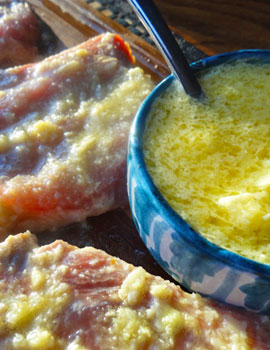
The key to making mojo is in the proportions.
INGREDIENTS:
(See instructions) garlic cloves (about 30 to 40 cloves)For a pig, we use four or five large HEADS of garlic! That's approximately 70 to 80 cloves.
Use a mortar and pestle.
For every ten cloves of garlic, add 1/2 teaspoon salt, six black peppercorns, and some oregano. Mash them all together into a paste. Scoop the paste out into a separate bowl. Continue this process until all of the garlic (all five heads) is mashed.
Stir in sour orange juice. (Five heads of garlic should be added to about 1 quart of sour orange juice to make a mojo for a whole pig.) Let sit at room temperature for 30 minutes or longer. Use immediately to season the pig or refrigerate for later use.
To make a smaller amount, reduce the amounts, but keep the proportions. For example, to make 1 cup of mojo, use about 1 head of garlic, 1 teaspoon of salt, 12 black peppercorns, and 1 cup sour orange juice.
TIP: This is a great marinade for just about anything, including pork chops as seen in the photo above.
Mash garlic, salt, and peppercorns into a paste, using a mortar and pestle. Stir in sour orange juice, onion, and oregano. Let sit at room temperature for 30 minutes or longer.
In a saucepan, heat olive oil to medium hot (approximately 220 degrees F) and remove from heat. Carefully whisk in the garlic-orange juice mixture (prepared above) until well blended.

This new Kindle version contains all of the recipes and editorial copy from the original print edition. As a bonus, the new Kindle edition includes 14 new photos of the prepared dishes.
Use the FREE Kindle Reading App and view our cookbooks on your notepad, tablet, laptop, or computer.
Drinks | Appetizers | Salads | Main Dishes| Soups | Side Dishes | Desserts | Index



Cuban, Spanish, and Latin American food recipes, Miami/Little Havana Travel Guide, Miami Restaurant Guide, Hispanic Culture & Food
No copying or commercial duplication of any content (including photos) without the express written permission of the authors and proper attribution.